Most students don’t have a career problem. They have a clarity problem.
That realization is what led me to build CareerSync AI.
The idea started from something I kept noticing around me in college. Everyone was learning random skills, taking random courses, and applying to random opportunities without really knowing why. One person wanted to become a product manager after watching a YouTube video. Another suddenly wanted to pivot into finance because “AI might replace developers.” Most career decisions were being driven by trends instead of structured planning.
At the same time, existing career platforms felt shallow. They either gave generic roadmap advice or spammed job listings. None of them actually analyzed who you are right now and mapped that against where you want to go.
I wanted to build something that behaved more like a strategic career advisor than a job board.
That became the foundation of CareerSync AI.
The Original Concept
The first version was much simpler than what the platform eventually became.
I initially focused on one core problem:
“If someone wants to pivot into a new industry, how do they know what skills they’re missing?”
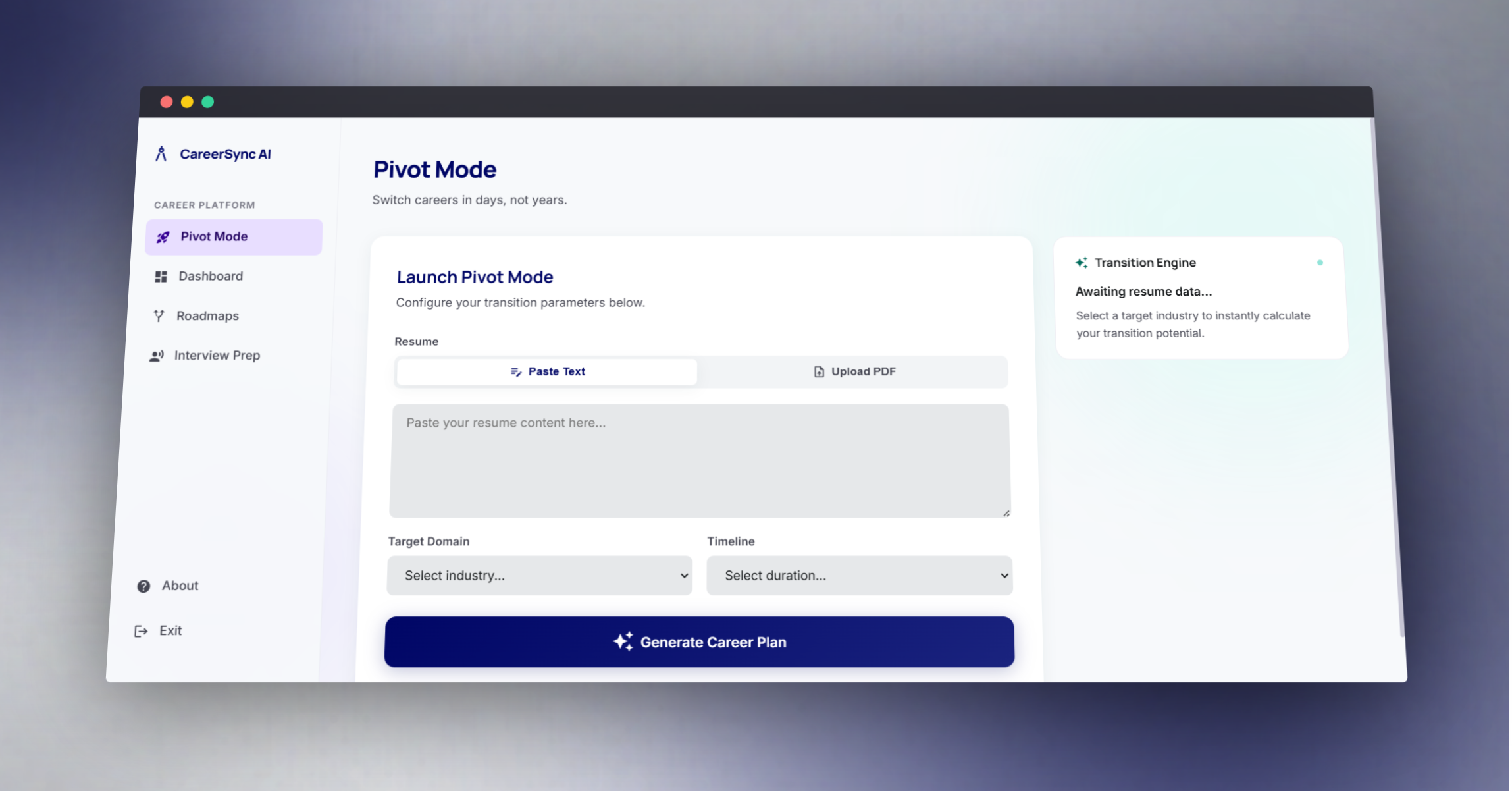
That led to the creation of what I called Pivot Mode.
The workflow was straightforward:
- Upload your resume
- Choose a target industry or role
- Let the AI analyze your existing skills
- Compare them against industry requirements
- Generate a gap analysis and roadmap
For example, if a computer science student wanted to move into finance, the system would identify transferable skills, missing competencies, and learning priorities. The interesting part wasn’t just generating a list of missing skills. I wanted the output to feel actionable.
So instead of saying:
- “Learn financial modeling”
The AI would generate phased preparation paths like:
- Phase 1: Foundational finance concepts
- Phase 2: Excel and valuation
- Phase 3: Market analysis projects
- Phase 4: Portfolio building and networking
That made the platform feel personalized instead of generic.
Building the System
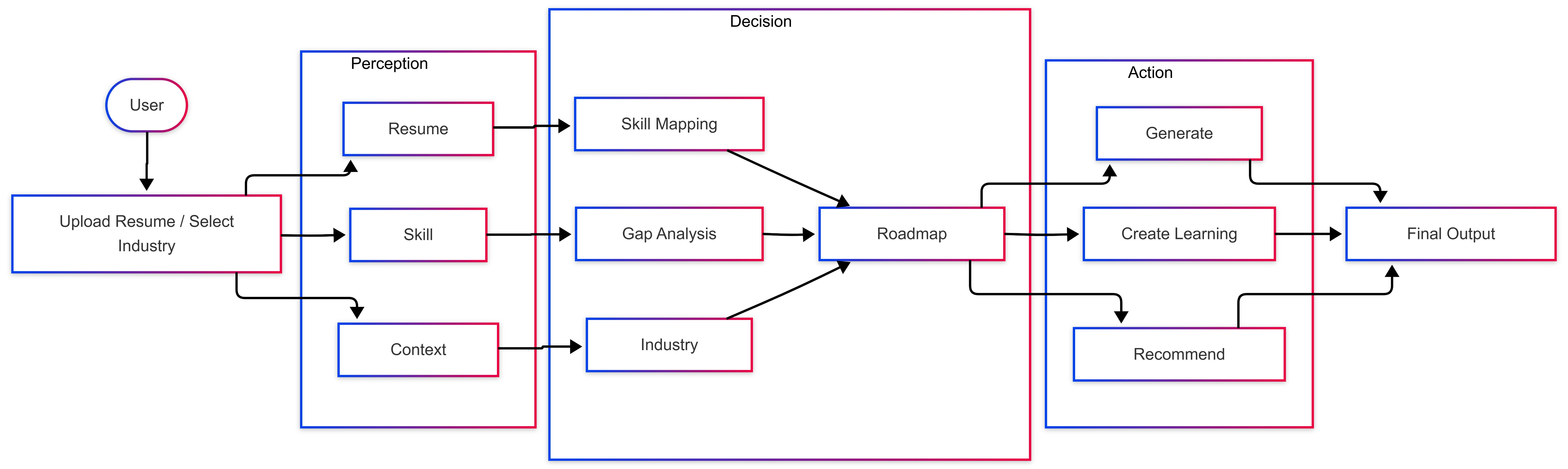
The project was built as a modern AI-powered web application using a fairly modular architecture. The frontend handled resume uploads, dashboard rendering, and roadmap visualization. The backend focused on parsing resumes, skill extraction, prompt orchestration, and AI-generated recommendations.
One of the biggest technical challenges was resume understanding.
Resumes are messy.
Different formats, inconsistent wording, PDF parsing issues, weird layouts — all of that makes extracting structured data surprisingly difficult. I spent a lot of time improving resume parsing reliability before even touching the “AI intelligence” layer.
Once the extraction pipeline worked consistently, I built the analysis engine around large language models.
The prompting system became the real core of the app.
I had to carefully design prompts that could:
- Understand transferable skills
- Identify career gaps realistically
- Avoid hallucinating expertise
- Generate practical roadmaps
- Maintain consistency across industries
This took multiple iterations because AI career advice can easily become vague motivational fluff if the prompts aren’t tightly structured.
I didn’t want CareerSync AI to sound like:
“Follow your passion and believe in yourself.”
I wanted it to sound like:
“You already have A, B, and C. To transition into this role, you need D, E, and F. Here’s the fastest sequence to get there.”
Challenges I Faced
One of the biggest challenges was balancing personalization with reliability.
AI is very good at sounding confident, even when it’s wrong. In a product related to careers, that becomes dangerous because users may actually make decisions based on the recommendations. I had to constantly refine prompts and system logic to ensure the outputs stayed grounded and realistic.
Another major challenge was dealing with inconsistent resume formats. Some resumes were highly structured while others were almost impossible to parse cleanly. A single broken section could completely affect the downstream analysis.
Performance was another issue.
Generating detailed career roadmaps requires multiple layers of analysis, which can increase response times significantly. I had to optimize how prompts were structured and how information flowed through the system so the experience still felt responsive.
The hardest challenge, though, was defining the actual scope of the product.
At one point, I was trying to add too many features:
- Resume scoring
- Interview prep
- Career prediction
- Job matching
- Networking recommendations
Eventually I realized the product was becoming bloated.
The real value of CareerSync AI wasn’t “more AI features.” It was helping users gain clarity about what to do next.
Once I understood that, the product direction became much sharper.
What I Learned
CareerSync AI taught me a lot beyond just technical skills.
First, AI products are not impressive because they use AI. They’re impressive when they reduce uncertainty.
Second, good UX matters more than model complexity. Even powerful AI outputs feel useless if the experience is confusing.
And third, building in public forces clarity. Explaining the product repeatedly helped me refine the actual problem I was solving.
The project also pushed me deeper into prompt engineering, system design, frontend architecture, and product thinking simultaneously. It became much more than just another college project.
Conclusion
CareerSync AI started as an experiment around career pivots, but it eventually became a much larger exploration of how AI can support decision-making. What interested me most was not the technology itself, but the impact of giving people structured direction during uncertain career phases. There are already countless platforms that provide information. Very few help users understand how that information applies specifically to them.
That gap is what I wanted CareerSync AI to solve.
Building it taught me that the best AI products are not the ones that feel the smartest. They’re the ones that make people feel less lost.